Easter Island 4-Day Itinerary: Make Time for the Moai
A workable Easter Island 4-day itinerary uses arrival and departure days lightly, with two full days for the island’s archaeological sites. Give Rano Raraku and Ahu Tongariki one substantial day, then Rano Kau and Orongo another. If sunrise, beach time, and extra sites all matter, add a fourth night rather than squeezing them into the hours before your flight.
I had just one day ashore on Rapa Nui. Seeing the moai at Rano Raraku and Ahu Tongariki made me wish I had more time to look closely. The four-day route below is a suggested plan for a longer stay; my first-hand observations come from those two places, not from personally following this whole itinerary.
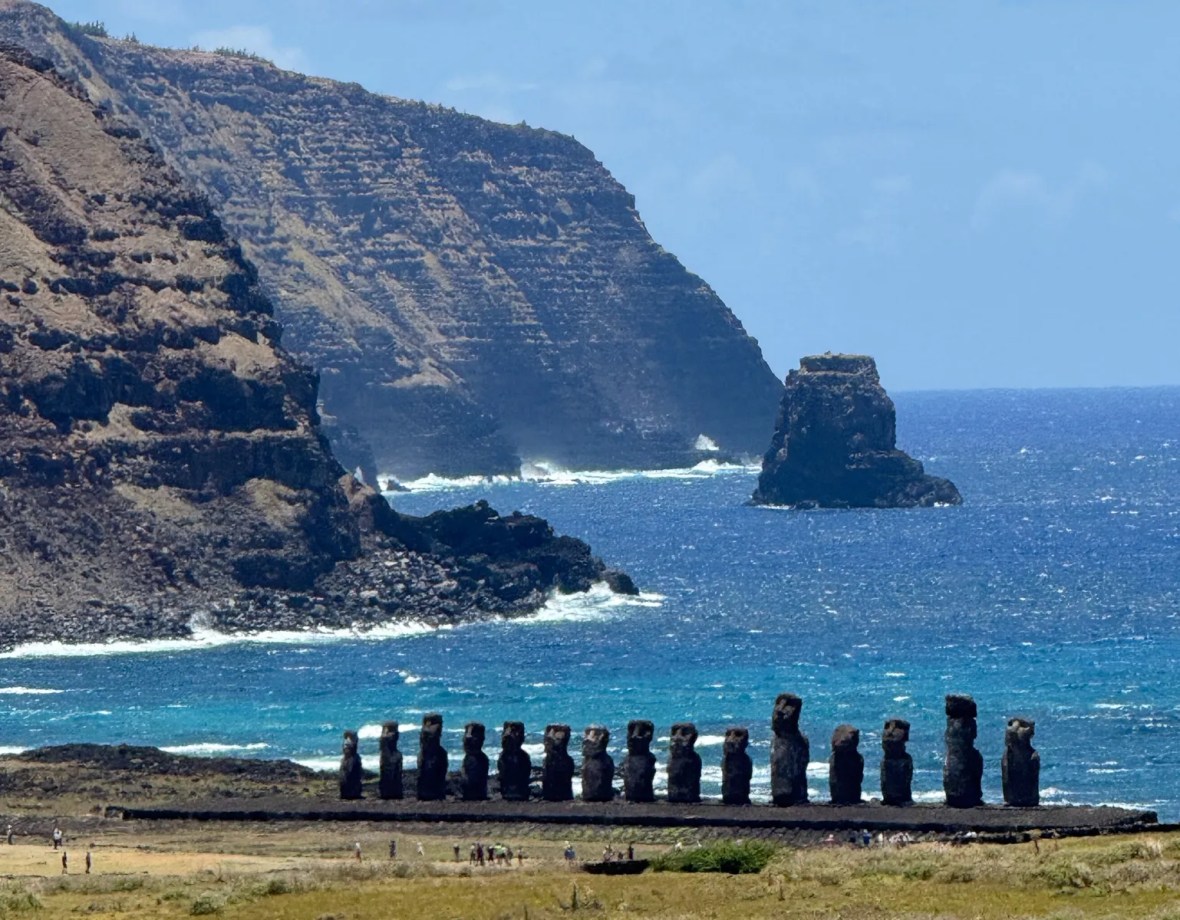
Official visitor information checked October 16, 2026. Featured photograph: my view of Ahu Tongariki.
Easter Island 4-day itinerary at a glance
| Day | Main plan | Keep flexible |
|---|---|---|
| 1: Arrival | Settle into Hanga Roa, get oriented, confirm the next day’s arrangements | Tahai around sunset if arrival and access arrangements allow |
| 2: Eastern sites | Rano Raraku and Ahu Tongariki with an accredited guide | Anakena beach afterward, or an earlier finish |
| 3: Crater and ceremonial village | Rano Kau and Orongo | One extra site only if the day’s route comfortably allows it |
| 4: Departure | A nearby breakfast, packing, and departure | A short town walk, not an essential archaeological visit |
Four calendar days usually mean only two full sightseeing days. Check your actual arrival and departure times before deciding that three nights are enough. My preference would be four nights if the budget allows: the extra full day gives you room to adjust the order with your guide and enjoy a slower beach or town afternoon.
Before setting the daily order
For travelers arriving by air, Chile’s official destination guide identifies Santiago (SCL) as the direct departure point for Mataveri Airport (IPC). Build the island stay around confirmed flights, and consider a buffer in Santiago before an important onward journey. This four-day plan starts on arrival on the island; it does not include travel to Chile.
There are two separate things to organize: permission to enter Rapa Nui and access to its national park. Completing one does not replace the other.
- Island entry: the current official entry guidance requires the FUI form within the 48 hours before your flight, a return ticket within the maximum 30-day stay, and a reservation at SERNATUR-registered accommodation or the prescribed resident invitation. Check Chile’s nationality-specific document and visa requirements separately.
- Archaeological visits: the Ma’u Henua park website requires an admission ticket and an accredited guide. Rano Raraku and Orongo each permit one visit per ticket. Confirm seasonal access hours with your guide before fixing the order.
Keep the confirmations accessible offline. Before committing to a daily plan, ask which sites it includes, how you will travel between them, and when you return to town. A vehicle solves the distance problem; it does not replace the guide requirement.
Day 1: arrive and get comfortable in Hanga Roa
Leave arrival day mostly open. Check in, find somewhere convenient to eat, and confirm where and when to meet the next morning. Hanga Roa is the island’s main town, and its center is suitable for exploring on foot. A short orientation walk is more useful today than trying to reach a distant site before closing.
Tahai is a possible sunset stop: the park describes it as a restored ceremonial complex and a sunset viewpoint. Treat it as optional, and confirm the current access arrangements for the area you want to visit. If arrival is late, have dinner and save the sightseeing for tomorrow.
This is also the time to ask about the forecast and your two full days. If one day’s conditions look better for your priority sites, discuss swapping days two and three before using either single-entry visit.
Day 2: Rano Raraku and Ahu Tongariki
Make room to look closely at Rano Raraku
Put the quarry and Tongariki together as the day’s main purpose. Agree the order and time at each stop with your guide; the outline here is not a fixed driving timetable.
What stayed with me: at Rano Raraku, some carved faces were obvious, while others seemed to disappear into the hillside until our guide pointed them out. I kept noticing details I had missed. It is somewhere I would give a generous block of time, rather than treating it as a quick photograph before the next stop.
The sun felt strong during my visit, and I was glad I had brought a hat, sunscreen, and a light sun-protection layer. Pack water and shoes you can comfortably walk in. Keep to the marked route and let the guide set the pace through the site.
See the line of moai at Ahu Tongariki
Ahu Tongariki’s restored platform has 15 standing moai. I visited in daylight; the row of figures against the ocean was memorable without a sunrise start. If you would rather have a normal breakfast and an unhurried morning, that is a perfectly reasonable choice.
If sunrise is a priority, arrange it explicitly with your guide and confirm that day’s access and departure time. Do not assume a normal daytime arrangement includes an early start. Ask how breakfast and the gap before the next site’s opening will work so the whole morning makes sense.
Add Anakena only if you still have time
Anakena offers a white-sand beach with Ahu Nau Nau nearby. Chile Travel distinguishes public beach access from visiting the ceremonial platforms, which requires an accredited guide. Make that distinction clear when arranging a beach stop and the ride back.
I would keep this as an optional finish, especially after a sunrise start. If adding the beach means hurrying through the quarry, save it for an extra day. Agree how long you can stay and how you will return before being dropped off.
Day 3: Rano Kau and Orongo
Use the second full day for a different landscape and part of Rapa Nui’s history. Rano Kau is a volcanic crater with a lake; nearby Orongo is the ceremonial village associated with the Birdman tradition. These are researched additions to this plan, not places I am claiming to have visited.
Give the crater and village a substantial morning block. Let the weather, your interest in the interpretation, and your guide’s advice determine the pace. Leave a lunch break before deciding whether the afternoon needs another stop.
If you want one extra outing, discuss Ahu Akivi or Puna Pau when arranging the day’s route. The former has seven moai; the latter is the quarry associated with the red stone headdresses. You do not need both to make the day worthwhile. A quieter afternoon in town may be more appealing after the previous day’s longer circuit.
The park’s conservation rules apply throughout: stay within marked areas, leave stones where they are, and do not touch or lean on the moai or ceremonial platforms. Follow local instructions even when a photograph looks easy to take from beyond a barrier.
Day 4: keep departure simple
Keep the last morning close to your accommodation. Have breakfast, collect anything you left behind, and follow your airline’s current check-in instructions. A short town walk is a bonus; an essential site visit belongs on a full day.
A late flight may leave more time, but I would only add an outing after agreeing a firm return plan. Keep luggage, checkout, transport, and check-in in the same calculation. Moving an important visit to departure morning removes much of the flexibility that makes this itinerary useful.
What to change for a shorter or longer stay
- Three days and two nights: you may have just one full day. Choose your priority circuit with a guide instead of compressing both full-day outlines into one.
- Five days and four nights: use the additional day for Anakena, a smaller site circuit, or breathing room between the main outings. Agree the order before using single-entry sites.
- Only a day ashore: start with the time you actually have available. My visit covered Rano Raraku and Tongariki, but that historical arrangement is not a guarantee that every short visit can repeat it.
If Rapa Nui is one leg of a wider South America trip, give each region its own arrival time. My three-day Cusco itinerary explains why that city’s days need a different, altitude-aware pace. It is a separate Peru leg, not a side trip from the island.
For packing, start with the outdoor essentials rather than a long equipment list. My minimalist travel gadget guide can help you decide which small extras earn space once your water, comfortable clothing, and sun protection are covered.
The strongest version of this trip gives the two main archaeological days room to breathe. Protect those days first, keep arrival and departure light, and add another night if your wish list includes both early starts and leisurely beach time.