Capsule Hotel vs Business Hotel in Japan: Which Fits Your Trip?
For a first solo trip, choose a business hotel with a private bathroom if sleep, privacy or returning to your room during the day matters more than the lowest price. Choose a capsule or cabin hotel when you are comfortable sharing facilities, expect to spend the day out and can verify that its luggage and access rules fit your plans.
The useful question when choosing between a capsule hotel and a business hotel in Japan is how you will use the accommodation. A cheap bed can work beautifully for sightseeing days and badly for jet lag, private calls or an afternoon rest. Compare the exact room category before comparing the price.
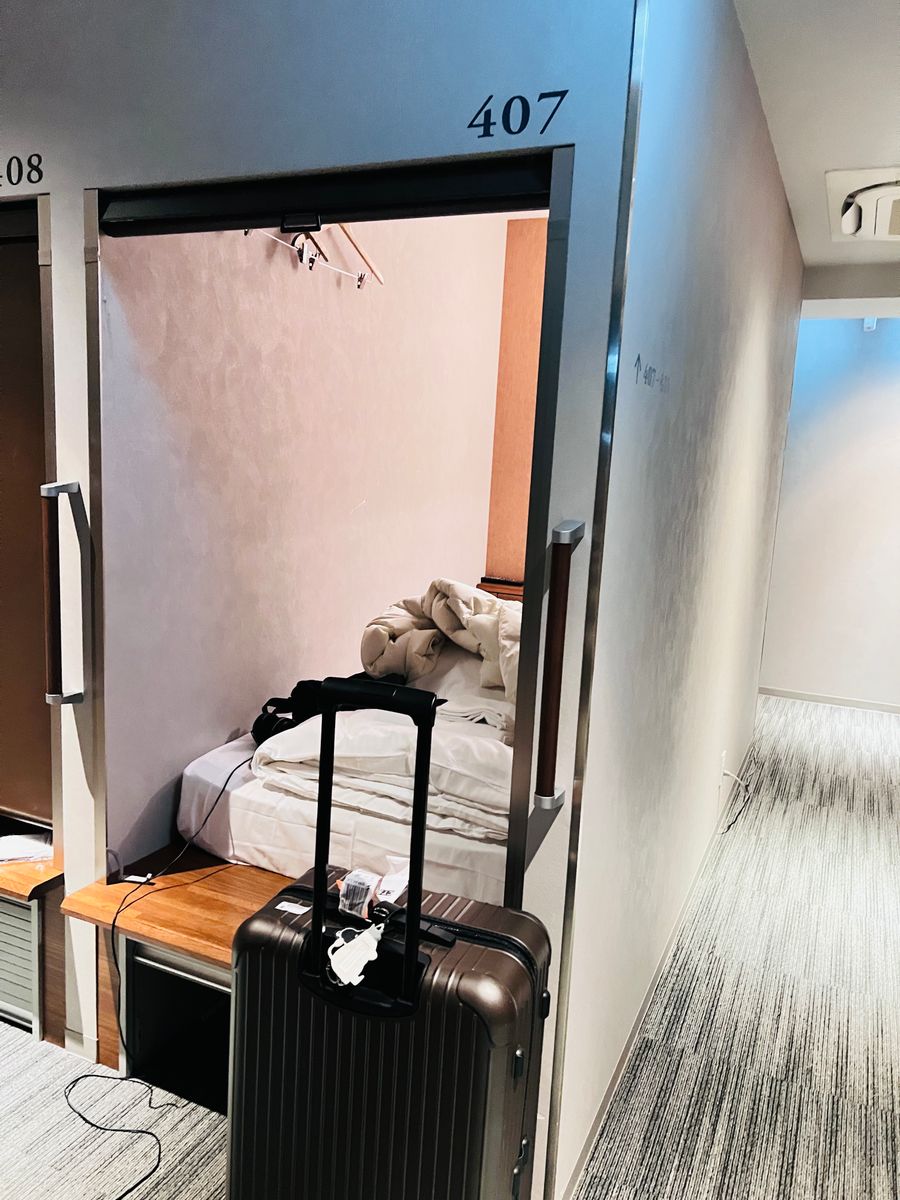
Hotel policies checked October 27, 2026. Personal observations below describe my earlier solo stay at Gardens Cabin in Sapporo. The featured photograph shows that cabin, not a typical room at every capsule hotel.
Affiliate disclosure: This article contains an affiliate link. Ritaishare may earn a commission if you book through it, at no extra cost to you.
Capsule hotel vs business hotel in Japan: the quick comparison
| Your priority | Capsule or cabin | Business hotel |
|---|---|---|
| Private space | A sleeping compartment; a screen or curtain may separate it from shared space | A private guest room; verify the bathroom arrangement |
| Sleep | Expect sound to travel between sleeping spaces | More separation, though noise still varies by property |
| Daytime rest | Some properties close sleeping areas for daily cleaning, including on multi-night stays | Better starting point for a room you can use during the day; confirm access and cleaning policies |
| Luggage | Locker dimensions and overflow storage can determine suitability | Check floor space if you need to open a large suitcase |
| Calls and work | Check lounge access and rules; the sleeping area may be unsuitable | Look for a desk and room privacy if work is part of the trip |
| Value | Compare the actual saving after any storage or other extras | Compare the premium for privacy over the whole stay |
GO TOKYO’s accommodation guide identifies business hotels as an option for greater privacy and notes that some capsule properties are women-only. Those labels are a starting point, not a substitute for reading the selected room’s details.
Separate three questions: door, bathroom and luggage lock
“Private” can mean different things in an accommodation listing. Check whether you have a lockable room door, whether the toilet and shower are private, and where valuables can be secured. A curtain around your bed does not answer all three questions.
For a concrete example, Gardens Cabin’s official room descriptions distinguish cabins that cannot be locked from lockable Double and Twin rooms. The regular rooms still use shared bathroom facilities. Its Standard and Deluxe cabins have lockable under-bed storage measuring 80 cm deep × 75 cm wide × 30 cm high. A bigger cabin therefore does not automatically buy the same privacy as a conventional hotel room.
Use that distinction when reading any listing: search within the room description for “shared bathroom,” look at the entrance in the room photos, and check the storage arrangement. If the description is unclear, ask the property before choosing a nonrefundable rate.
Decide how much of the day you need the room
Draw a simple timeline for your arrival day and one ordinary sightseeing day. Include the time you land, the first time you can check in, any afternoon break and the time you plan to return at night. This often makes the choice clearer than a list of facilities.
The nine hours FAQ currently says consecutive-night guests cannot use the capsule during cleaning from 11 a.m. to 3 p.m.; Narita Airport instead lists 10 a.m. to 2 p.m. Guests must go out or use a lounge where available. It also asks arrivals after midnight to notify the property in advance.
Those are operator-specific rules. Do not assume every capsule hotel has the same restriction, or that booking several nights removes it. If you want a midday nap, ask about that exact time window. If your flight arrives early, a normal hotel reservation also does not automatically include early check-in.
Check luggage for both the stay and departure day
Measure your packed suitcase, including wheels and handles. Then check three separate things: whether it fits the assigned storage, where you can open it, and what happens after checkout. A bag that fits when closed may still be awkward to unpack beside sleeping guests.
At nine hours, the FAQ says oversized bags can generally be held at reception, with an exception at Narita Airport, which directs guests to airport storage. It does not offer luggage storage after checkout. That matters if you have a full sightseeing day before an evening departure.
Before booking, price any separate storage you would need and check that collecting the bag fits your departure route. For a business hotel, verify storage too rather than assuming it is included. Room photographs are useful for judging suitcase space, especially when the bed nearly fills the floor.
What my solo cabin stay taught me
On my Gardens Cabin stay, my 29-inch suitcase fitted into the under-bed storage. I liked having access to the shared bath after a day out, and the cabin suited a trip where I spent little daytime there. I still heard occasional snoring: comfortable for me did not mean soundproof.
The practical lesson was to judge the whole routine. Storage and bathing facilities made the small sleeping space work for me; someone needing a quiet room for calls or daytime rest could reach a different conclusion. My Gardens Cabin Sapporo review covers that particular stay and room choices in more detail.
For women traveling alone, check the exact category
If you prefer a women-only sleeping area, make sure the selected rate explicitly books that category. A property can have several types of accommodation, and its main photos may not show the space attached to the cheapest result.
Check access controls, reception arrangements and the route from the station to the entrance. Read recent comments about noise, shared facilities and luggage handling. A women-only label can describe who uses an area; it does not by itself establish security, silence or a private room.
Choose the accommodation format first, then the neighborhood. If your trip includes Kyushu, the separate Fukuoka accommodation-area comparison explains the location tradeoffs between Hakata, Tenjin and other bases.
Compare the total saving, then book
Shortlist one suitable capsule and one suitable private room for the same dates and one adult. Compare the total payable amount, cancellation deadline, bathroom type, breakfast and any storage needs. A headline rate for a different occupancy or a nonrefundable plan is not an equivalent comparison.
Divide the total price difference by the number of nights. Then ask what that nightly premium buys you: a lockable room, private bathroom, space to repack or a place to rest. There is no universal saving that makes shared accommodation worthwhile.
A practical starting point is to compare Japan accommodation for your dates on Booking.com. Select your city and one-person occupancy, then confirm the room details and policies with the property before paying.
If you are curious about capsule accommodation but unsure about shared sleeping space, consider trying one night rather than committing the entire trip. Factor in the extra checkout and luggage move. For a trip built around uninterrupted rest, a private business-hotel room is the more useful starting point; for full sightseeing days with meaningful savings, a carefully checked cabin can make sense.