Fukuoka Travel Guide: Plan Your First Visit
For a first Fukuoka trip, allow two full days for the city, then add a day for each substantial excursion. That is a planning recommendation, not a checklist you need to complete. A short visit works well if you want food, neighborhood walks, and shopping; it feels much tighter if you also expect to see several parts of Kyushu.
This Fukuoka travel guide helps you decide how much usable time you have, what belongs together on the map, and what to arrange first. The key choice is whether Fukuoka is your destination or your departure point for somewhere else.
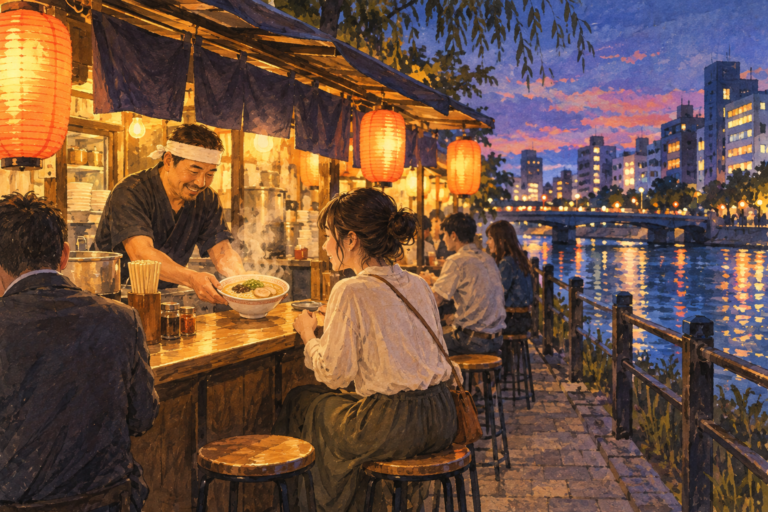
Planning information checked October 8, 2026. Check the linked operators for your dates. Featured image: AI-generated editorial illustration of an imagined travel-planning scene.
Is Fukuoka the right fit for your trip?
Fukuoka suits travelers who enjoy making a day out of a good meal, a park, a few shops, and an unhurried neighborhood walk. Hakata provides major regional transport connections, while Tenjin concentrates shopping and dining. JNTO’s Fukuoka city overview is a useful introduction to those roles.
Choose it as a city break if you want that mix. If your main goal is a mountain landscape, an onsen stay, or a particular distant attraction, check the journey before deciding to sleep in Fukuoka every night. Repeated returns can consume the time that made a single base appealing.
For an independent traveler, a manageable plan starts with one main outing per day and a flexible meal afterward. You can add more once you know your energy, the weather, and the actual travel time from your accommodation.
Fukuoka travel guide: count full days before nights
| Usable time | A reasonable focus | What to leave out |
|---|---|---|
| One full day | One cultural or outdoor area, plus one food and shopping area | A distant regional excursion |
| Two full days | Hakata’s older streets and central neighborhoods, then Ohori and Tenjin | The pressure to visit every nearby town |
| Three full days | Two city days plus Dazaifu or another chosen excursion | A second major day trip unless you deliberately reduce city time |
| Four or more full days | City time, one or two outings, and room to move plans around | Automatically filling every spare day with a long bus ride |
These are suggested allocations, not transport schedules. A three-night booking with a late arrival and an early departure gives you two full days. A four-night booking does not necessarily give you five sightseeing days.
Before paying for anything, write down when you expect to reach your accommodation on arrival and when you must leave it on departure. Keep the first evening local. If an excursion is the reason you are traveling, reserve a full day for it before deciding how much city time remains.
Group city sights into three manageable areas
The city’s official first-time visitor guide highlights Hakata Old Town, Ohori Park, and the waterfront as different parts of the city. Choose the atmosphere you want, then build around that area.
Hakata Old Town and the central riverside
Choose this side for shrines, temples, and older streets, with Kushida Shrine and Tochoji among the established sights. It offers a useful counterpoint to the modern station district. Select a small number of places you actually want to enter; a map full of pins does not account for time spent looking around.
Use the afternoon or evening for a nearby meal or the central riverside rather than immediately crossing the city for another attraction. Check individual venue hours if a specific interior is essential to your day.
Ohori Park, Maizuru Park, and art
Ohori suits a slower outdoor block. Maizuru Park and the Fukuoka Castle ruins are nearby, and Fukuoka Art Museum provides an indoor option by the park. This is a good choice when you want walking and a sit-down break between busier shopping districts.
Do not assume the museum is available on any rainy day. Its official visitor page lists Monday closures, moving to the following weekday when Monday is a national holiday, plus a year-end closure and possible exhibition changes. Check the calendar before using it as your backup.
Tenjin and Daimyo
Choose this area when shopping, cafes, and dinner matter more than a sequence of major sights. Keep a few open hours here instead of treating every shop as an appointment. The city’s area guide helps distinguish the central districts from outings farther away.
Momochi’s waterfront can be a separate choice if the sea interests you more than shopping. Avoid treating every place within Fukuoka as though it were on the same walking route.
Choose your base around the journeys you will repeat
Start by listing your fixed departures. Hakata makes sense when regional trains or a Hakata meeting point drive the plan; Tenjin deserves a closer look when most of your time stays in the city or your outing starts on Nishitetsu. Use the Fukuoka accommodation-area comparison for the full tradeoffs, including quieter alternatives.
Then compare actual addresses. A room described as “near the station” can still involve the wrong exit, a long underground walk, or stairs with luggage. Check the route from the platform or meeting point you need, along with check-in limits, luggage storage, and bathroom arrangements. Those details matter more than the district label alone.
Getting around: understand the networks before buying anything
For a central city trip, start with walking and the subway. The official subway map shows the Airport, Hakozaki, and Nanakuma lines. Tenjin and Tenjin-minami are different stations; Nishitetsu Fukuoka (Tenjin) is a separate railway station. Save the full station name when following directions.
Airport access also depends on the terminal. The airport’s subway directions place the subway connection at Domestic; International passengers using that route first take the terminal shuttle. The Fukuoka Airport transport guide compares that connection with direct buses and explains their payment differences.
Decide your routes before considering a pass. Write down the operator for each journey and compare the current eligible fares with the pass price and validity. A city subway day and a regional excursion are different purchases; do not assume one product covers both. No car is needed for the central plan described here, but an outlying destination may require additional transport research.
Pick one excursion for the time you actually have
Dazaifu for a focused outing
Dazaifu Tenmangu is a practical option when you want a shrine visit outside central Fukuoka. Its official access guide describes the Nishitetsu route from Fukuoka (Tenjin), changing at Nishitetsu-Futsukaichi for Dazaifu. This is a separate journey from the city subway.
Allow a generous half-day as a planning starting point, and extend it if you want museums, a leisurely lunch, or more walking. Check the shrine’s current notices and your return connection. Adding Yanagawa or another destination turns it into a different day; confirm the complete route before combining them.
Takachiho when it is a priority of its own
On my five-day Kyushu trip, I used one day for a guided Takachiho excursion from Fukuoka because I was traveling alone and did not want to drive. Having the transport arranged was useful, but each stop had a fixed return time. That experience is why I would protect the whole day rather than plan it as an add-on to city sightseeing.
Read the Takachiho day-trip review for the tradeoffs. If the gorge or a slow visit is your main purpose, compare an overnight plan before committing to the return journey.
Check current Takachiho day-tour options on KKday. Confirm the selected departure’s language, meeting point, walking demands, cancellation terms, and whether boating is included. A tour title or English listing does not establish every package’s inclusions.
Disclosure: The KKday link is an affiliate link. Ritaishare may earn a commission at no extra cost to you.
Leave room for food without scheduling every meal
Choose one meal that matters each day, then keep alternatives near the area you are already visiting. For a traveler eating alone, portion size, counter seating, and the exact branch are more useful checks than a long restaurant wish list.
The Fukuoka food itinerary for solo travelers provides a concrete meal plan. Use it as a menu of possibilities if you also want sightseeing time; you do not need to complete every food stop.
If a yatai evening appeals, have an indoor backup and consult the city’s official yatai information. Weather and individual stall operations can affect the evening. Check the menu and payment arrangements before ordering rather than relying on another stall’s rules.
Book in this order
- Set the trip’s purpose and usable days. Decide whether city time or an excursion is the priority.
- Check the fixed commitments. Look at your chosen excursion’s dates and meeting place before settling on a base.
- Choose accommodation with a workable route. Compare the exact address, arrival time, and cancellation terms.
- Arrange only the transport you need. Check terminal access and specific regional journeys; compare passes after the route is clear.
- Keep city blocks flexible. Move park time to better weather, check museum closing days, and leave meals near your day’s final neighborhood.
Budget from those same choices: accommodation for the actual nights, airport journeys, local transport, meals, and any excursion or admission costs. Get dated quotes for the expensive commitments first. A single daily average can hide the cost of a regional outing or a particular room type.
For a first visit, two full city days and one carefully chosen excursion make a useful starting plan. If your available time is shorter, reduce the map rather than shorten every stop.