
Should You Stay in Ollantaytambo Overnight?
Should you stay in Ollantaytambo overnight? For an early train to Machu Picchu, I would: completing the road journey the day before removes one connection from an already busy morning. An overnight stay is also worthwhile if you want time in the old town. If your transport from Cusco is already coordinated with a later train and you have little interest in exploring, a transfer stop can be enough.
I stayed at Parwa Guest House with companions before taking the train onward. We arrived close to midnight, so the stay helped with the following morning but left almost no time to enjoy the town that evening. That distinction matters: sleeping here makes the journey easier to organize, while arriving earlier is what gives you a proper visit.
This article contains an affiliate link. If you book through it, I may earn a commission at no extra cost to you. Rail and accommodation information was checked on September 29, 2026; confirm the terms for your dates before booking.
Stay in Ollantaytambo overnight or pass through?
| Your situation | Best fit | Main tradeoff |
|---|---|---|
| Early train departing from Ollantaytambo | Stay the previous night | One more hotel check-in, but no same-morning road journey from Cusco |
| Later train with a coordinated transfer | A transfer stop may suffice | Less luggage unpacking, little time to explore |
| You want old-town walks and the archaeological site | Allow an afternoon and night, or two nights | More time in the Sacred Valley means less time elsewhere |
| Your priority is a very early Machu Picchu entry | Compare sleeping in Machu Picchu Pueblo | An Ollantaytambo hotel still leaves a train journey before you reach that town |
| You reach Cusco late at night | Compare a Cusco night with a prearranged onward ride | Do not book an early train on the assumption that every arrival and transfer will run smoothly |
The useful question is where you want the longest connection to fall: the afternoon before your train, or the morning of departure. An overnight stop shifts the road journey earlier; it does not remove it from the trip.
Understand the three places before booking rooms
Ollantaytambo is a Sacred Valley town and a rail departure point. Machu Picchu Pueblo, also called Aguas Calientes, is the town reached by the train. The Machu Picchu archaeological site is a separate onward visit. A room in Ollantaytambo is therefore not interchangeable with a room in Machu Picchu Pueblo.
Start with your intended site visit, then check whether your train arrival leaves enough time for the onward connection and entry requirements. If the timing does not work, change the overnight location or the train rather than assuming the places are close enough to improvise. Confirm actual availability before committing to nonrefundable rooms.
Also read the complete rail itinerary. A ticket involving Cusco can include a road segment; do not assume every displayed departure point is where you board the train. PeruRail’s boarding guidance identifies its different stations and asks passengers to arrive 30 minutes before departure with a valid passport or identity card and a digital or printed ticket. Follow any additional instructions on your own booking.
What my late arrival taught me
After flying from Lima to Cusco, we continued to Ollantaytambo and reached town near midnight. The normal restaurant options we had hoped to try were no longer available to us, and we ate at a roadside stall. I would not use that experience as a plan for finding a late dinner today.
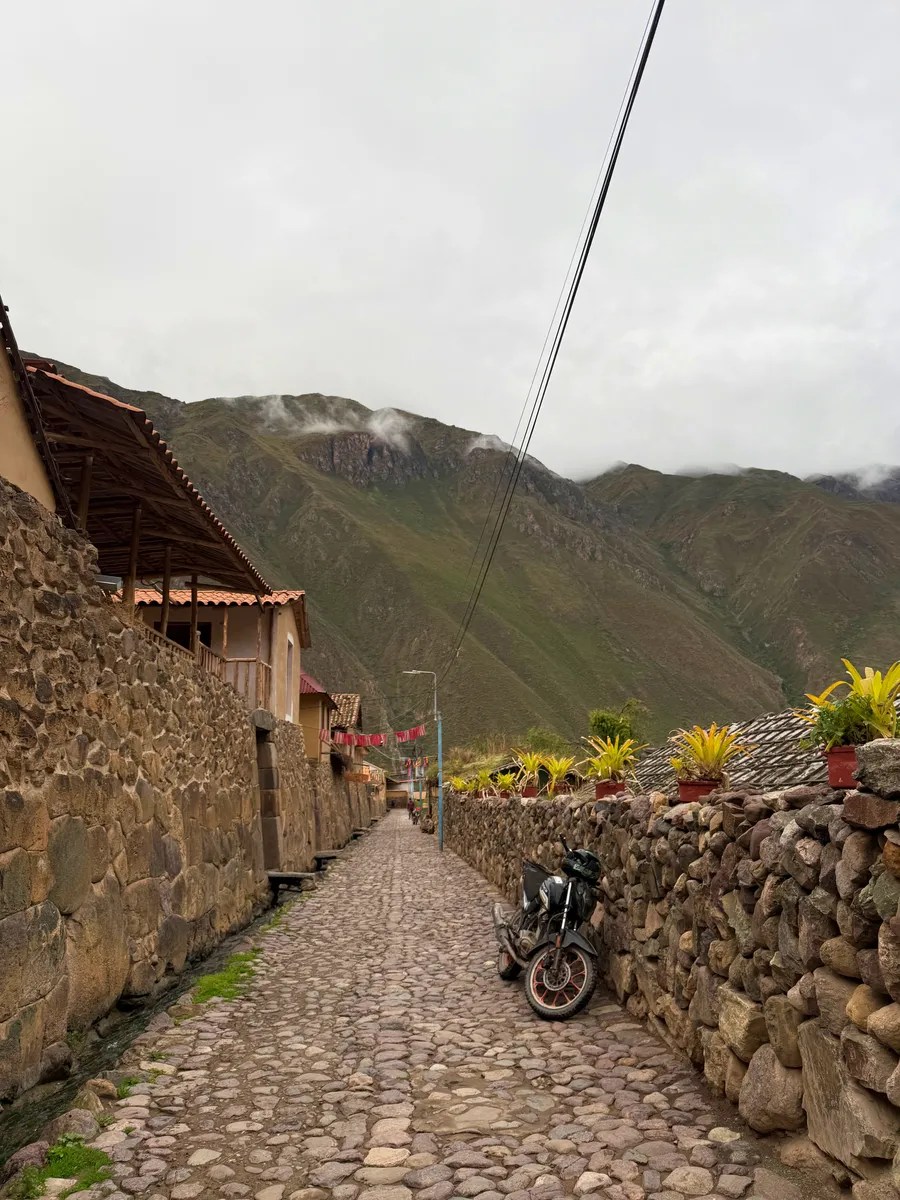
What I remember most clearly is entering the stone streets in the dark, then seeing the mountain setting properly the next morning. The running water and old streets made me wish we had arrived with daylight left. Peru’s official tourism site describes the preserved streets and water channels; they are a reason to give the town time beyond the station.
If you are arriving late, arrange the ride and accommodation reception in advance. Send the flight details, agree on a delay contact, and ask where the driver can stop relative to the entrance. Have a food plan before leaving Cusco. A confirmed room does not answer those arrival questions by itself.
Old town or train station: choose the location first
Old town for an evening and a walk
I stayed at Parwa Guest House in the old town, not at its neighboring sister property Iskay. Our four-person room had two double beds and a small table-and-chair area; I found the owner friendly and enjoyed the mountain outlook the next morning. Those are impressions from my stay, not a guarantee of the layout or view in every room.
The old-town setting worked for seeing the streets, but the station felt a noticeable distance away to me. Compare the accommodation entrance, Plaza de Armas, and your rail meeting point on a map before booking. Uneven paving, luggage, darkness, and rain can make a short-looking route less convenient.
The official Parwa and Iskay site presents the two properties together. Check which building and room you are reserving, then ask about late arrival, an early breakfast, luggage storage, and help getting to the station. Do not assume a sister property’s facilities are included without confirmation.
Check Parwa Guest House rooms and cancellation terms
The station for a simpler departure
El Albergue describes its location as inside Ollantaytambo train station. That makes it a useful alternative to compare when the next morning’s departure matters more than staying in the old town. I have not stayed there.
Even with a station location, confirm where to present yourself for your particular service and how to reach it from the room. Ask about early breakfast and the room’s position if train activity or noise would affect your choice. Proximity is a practical advantage, not a reason to arrive at the platform at the last minute.
A realistic one-night plan
Afternoon: arrive, check in, and walk through the old town around Plaza de Armas. Leave your larger bags at the accommodation while exploring. If the archaeological site is a priority, check its current admission arrangements and allow a separate, unrushed block of time; do not make it an automatic extra before a fixed train.
Evening: eat nearby, agree on your morning route, and pack the small bag you will take onward. Confirm breakfast timing instead of discovering at checkout that it starts after you need to leave.
Morning: work backward from the rail operator’s reporting time, adding your journey from the hotel, any luggage handover, and a margin for finding the correct entrance. Set the hotel departure time the night before.
If you arrive as late as I did, reduce the plan to food, check-in, packing, and sleep. Consider an additional night only if it creates real sightseeing time. Two nights with a full day between them serve a different purpose from two late arrivals separated by an excursion.
Sort out luggage and the return journey together
I left my 36-liter backpack at the hotel and took a foldable 16-liter daypack onward. The useful part of that arrangement was carrying only what I needed; bag volume alone does not establish compliance with a rail operator’s weight and dimension limits.
PeruRail’s luggage page lists complimentary passenger storage at Ollantaytambo station from 04:15 to 21:00, along with options for extra luggage. Confirm the allowance for your booked service and that storage hours cover your actual return. For another operator, use that operator’s rules rather than applying PeruRail’s policy.
- Returning to Ollantaytambo: check whether bags will wait at the station or hotel, and how long collection will take before your road transfer.
- Continuing toward Cusco: avoid leaving bags somewhere your return ticket bypasses. Check the full route before choosing storage.
- Using hotel storage: ask whether it is available after checkout or without another booked night, what it costs, and when you can collect.
- Packing the smaller bag: keep your identification, tickets, essential personal items, and the clothing needed for the overnight portion accessible.
For the wider trip, my minimalist travel gear guide can help you think through what deserves bag space. Check train limits before adding equipment.
When I would skip the overnight stay
I would consider passing through if a later train and coordinated transfer already fit the trip, if changing hotels would create more work than it saves, or if the priority is sleeping in Machu Picchu Pueblo before the site visit. In those cases, an extra Ollantaytambo night needs to earn its place through time you actually want to spend in town.
For an early departure from Ollantaytambo, though, I would choose the overnight stay and aim to arrive before dinner. My own rushed arrival delivered the transport benefit. An earlier arrival would have added the part I missed: time to enjoy the streets, eat without hurry, and prepare for the next morning.